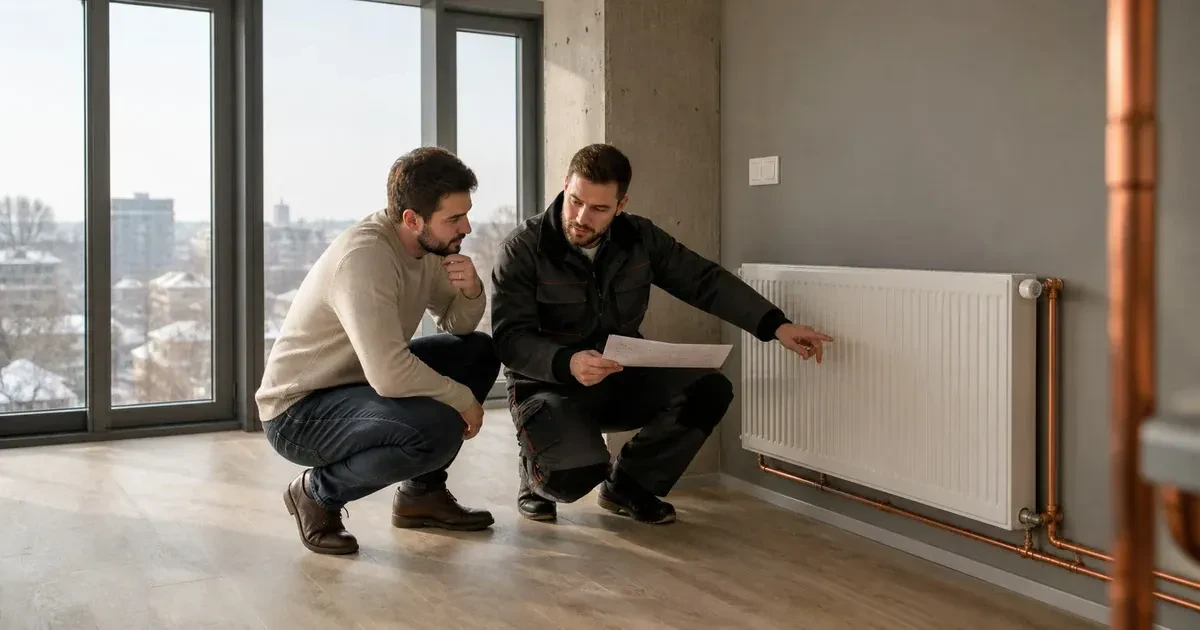
District heating in a new-build Sofia apartment: what a buyer checks
“District heating” in a listing does not tell you how the new apartment will actually be heated. Verify the building's connection status, the internal installation, the metering method and the costs that remain shared. The answer sits in the technical project and current connection documents, not in a single phrase in the sales brochure.
Toplofikatsiya Sofia describes connection as a sequence involving initial data, coordination of investment designs, a technical opinion and a contract. A nearby heat main therefore does not prove that a particular new building will receive heat. See the supplier's new-client connection procedure, in Bulgarian.
Sources were checked on 1 September 2026. The solution and status of a particular project must be confirmed from its current HVAC documentation and the supplier.
First establish whether the building is being connected
Ask a precise question at the viewing: will the building connect to the district-heating network, and which stage of the procedure has been completed? A planned solution, a technical opinion, a coordinated design, a signed agreement and a completed connection are different milestones.
You do not need to assess the engineering design yourself. You do need to see which document supports the sales statement. If construction is ongoing, ask what remains before individual accounts can be opened and who is responsible for completing it.
For Pirotska, request the current answer for the selected apartment and stage. This article does not declare the project's heating system without the supporting document.
How heat reaches the apartment
After the connection point come the building substation and internal heating installation. A buyer should understand the risers, controls, metering and domestic hot-water arrangement. Ask whether common pipes pass through spaces whose use matters to you.
Request the relevant installation plan for the apartment type and the equipment specification. If the offer says “individual metering”, establish what is measured individually and what is allocated at building level. The phrase does not necessarily mean that the bill contains only energy passing through radiators inside your home.
An HVAC engineer can be valuable when heating is a material part of the decision. A short review of the plan is more useful than years of assumptions based on a sales label.
Individual use is not the whole bill
In a condominium building, the heating installation operates as a system. Billing can include individual consumption, common-area energy and a building-installation component under the applicable rules and configuration.
Do not use another household's bill as a forecast. Orientation, area, target temperature, heated neighbouring units, total building use and the metering method can change the outcome. Regulated prices also change and should be checked with the supplier and Bulgaria's Energy and Water Regulatory Commission.
The useful questions are narrower: what is the designed system, how is consumption measured, and which charges can arise even with limited personal use? That lets you compare operating models instead of marketing claims.
Checks at handover
At handover, compare the installed equipment with the specification: emitters, controls, meters and access to them. If the meters are active, record starting readings in the handover protocol.
Ask who organises heat-cost allocation and the opening of individual accounts. Toplofikatsiya Sofia publishes separate information about metering and remote-read equipment. Metering guidance, in Bulgarian
Do not accept a generic “installations operational” note where there is a visible discrepancy. Describe the actual item and attach a photograph.
Comparing district heating with another system
Use the same assumptions for each option. Include initial equipment, annual maintenance, common components, energy prices and the way you expect to occupy the home. Air conditioning, heat pumps, electric underfloor heating and district energy have different capital and operating profiles.
There is no universal winner. A small apartment occupied intermittently may favour one pattern. A family home with regular hot-water use may favour another. The quality of the building envelope matters in every case.
Frequently asked questions
Does a nearby network mean the building will have district heating?
No. The particular project needs technical feasibility and a completed connection process. Ask for its documents instead of relying on neighbouring buildings.
Can I simply leave the radiators off?
You can control personal use within the system, but that does not necessarily create a zero bill. Confirm the applicable building and apartment components.
What should the purchase documents say?
The contract and technical specification should identify the agreed completion standard and included equipment. Connection status is supported by the separate design and supplier documents.
Verified sources
- Toplofikatsiya Sofia: new-client connection procedure, Bulgarian
- Toplofikatsiya Sofia: metering guidance, Bulgarian
- Bulgarian Energy and Water Regulatory Commission
For the wider commercial comparison, use Pirotska's guide to reading an investor's offer, in Bulgarian. At a Pirotska viewing, ask for the current technical specification for the selected unit.