Completed or off-plan in central Sofia? Compare the cost of actually moving in
A completed home is more suitable when your moving deadline matters most and you want to inspect what has been built. Buying off-plan may make sense if you can wait and the particular offer compensates for the uncertainty. Compare the cost of moving in, not just the advertised price: a commissioned building does not necessarily contain a finished, furnished apartment.
In central Sofia, two similarly sized homes can offer very different daily experiences. Windows, vehicle access, common areas and space to work from home do not become equivalent merely because the addresses are close. Before comparing construction stages, make sure you are comparing sufficiently similar properties.
What does “completed” actually mean?
In a listing, the word may refer to a completed building, an apartment with finishing works or a fully furnished home. These are three different starting points for your budget. Request a description of the handover specification instead of relying on photographs of an illustrative interior.
Check the exact commissioning document too. “Act 16” is commonly used as shorthand, but the paperwork differs by construction category. Categories one to three require a permission for use; categories four and five receive a commissioning certificate. Source: Ministry of Economy.
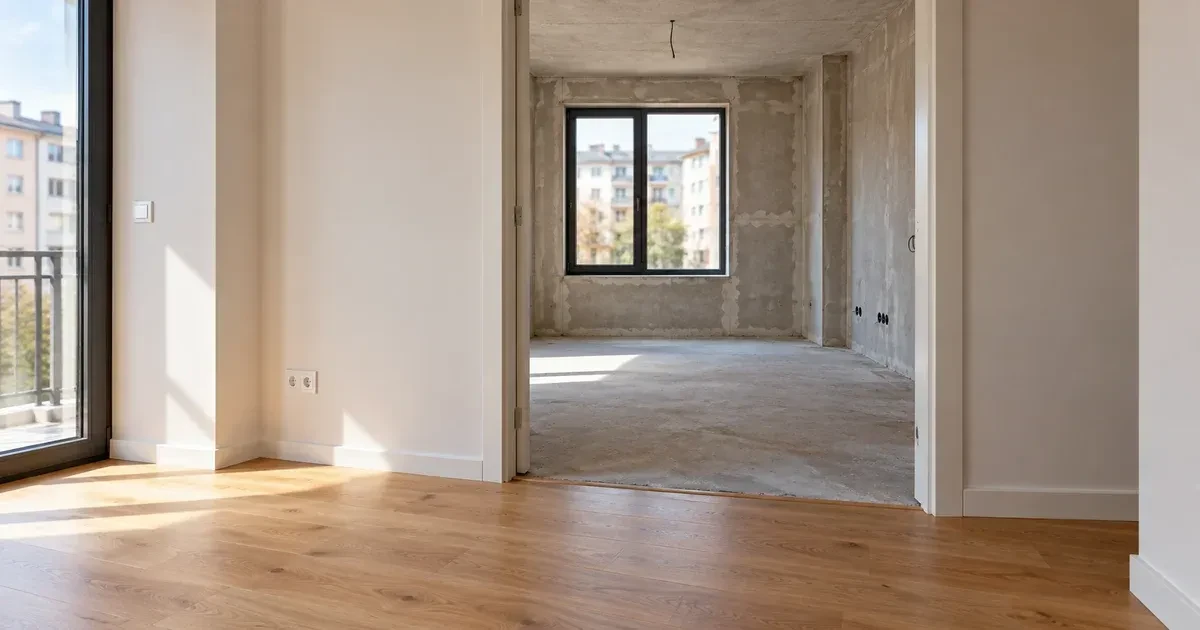
That document does not tell you whether the apartment has a kitchen, finished bathroom or light fittings. A property delivered with plastered walls and floor screed still requires quotations, deliveries and tradespeople. Their lead times belong in your moving schedule even when the building is already commissioned.
Compare like with like before comparing prices
Record what each offer includes. Is floor area calculated on the same basis? Is there storage? What is the parking arrangement? What finishing specification is contractual, and is the quoted price inclusive of applicable taxes?
Then assess the characteristics a renovation will not fix. Floor level, layout, natural light and the view towards a neighbouring building remain after a new kitchen is installed. A cheaper apartment with an awkward living room does not become equivalent to another simply because both have one bedroom.
With an off-plan purchase, establish which changes are actually permitted and until when. Do not assume you can move walls or services freely. Obtain confirmation of the scope, cost and how any agreed changes will be reflected in the design and contract.
There is no universal rule that off-plan homes must be cheaper. You need comparable actual offers, not a discount percentage from a general market article. Likewise, a claim that completed new homes in the centre are “almost sold out” is not a reason to rush without checking available alternatives.
Put a price on waiting
If you currently rent, a longer wait until moving in is a real expense. Storage, a second move and different financing costs may add to it. These are not part of the seller’s asking price, but they are part of your decision.
Consider two hypothetical apartments with identical finishing budgets. The figures are not Pirotska offers or estimates of Sofia market prices. Assume rent of €800 a month until moving in, three months of preparation for the completed home and a total of 18 months’ waiting and finishing for the off-plan option.
| Cost in the illustrative scenario | Completed home | Off-plan purchase |
|---|---|---|
| Purchase price | €220,000 | €205,000 |
| Finishing and furnishing | €30,000 | €30,000 |
| Rent until moving in | €2,400 | €14,400 |
| Subtotal of these items only | €252,400 | €249,400 |
The original €15,000 difference in purchase price has narrowed to €3,000 across the included items. Another six months at the same rent would raise the second subtotal to €254,200, making that scenario €1,800 more expensive than the first.
This is not a complete purchase budget. Acquisition costs, finance, maintenance, possible changes in finishing prices and the cost of tying up your own capital are excluded. Add those separately for each offer. The lesson is not that waiting is always poor value. It is that the discount matters only after you account for the cost of waiting.
Plan an actual move-in date
Separate the construction timetable from your moving timetable. Commissioning, handover, finishing works and furniture delivery are distinct events. Check which deadline the contract commits to and which is only an estimate discussed with the sales team.
If you must leave your current home on a fixed date, arrange a fallback for the period afterwards. For a family planning around the school year, a six-month delay may matter more than the difference between two asking prices. The decision does not have to be reduced to investment returns.
Create a schedule for a completed apartment too. Find tradespeople before assuming work can begin the day after completion of the purchase. Check kitchen and bathroom lead times, building renovation rules and delivery access. Commissioning removes one uncertainty, not the entire practical workload. The separate furnishing and moving-in guide for central Sofia, in Bulgarian, explores the preparation in more detail.
Look beyond the apartment during the viewing
For a completed property, allow time for a technical inspection, using a specialist where appropriate. Visible surfaces alone do not establish the condition of services or workmanship. Ask for identified defects and agreed remedies to be recorded at handover.
For a property under construction, more of the assessment rests on the design, contract, documentation and work completed so far. A visualisation shows an intention; it does not certify materials, dimensions or delivery dates. Record important specifications in the agreement rather than leaving them as a memory of the presentation.
At a central Sofia address, inspect the route from the street to the front door. Can furniture deliveries be made practically? What exactly is the proposed parking arrangement, and how is it used? What do neighbouring buildings and noise levels mean with the windows open? Visit at different times. That is more useful than a generic description of a “well-connected location”.
If the purchase depends on a mortgage, send the actual property documents to the lender. A completed home does not guarantee immediate approval. For a construction-stage purchase, do not assume drawdowns match the seller’s instalments without checking.
Choose according to your main constraint
Where a moving deadline is firm, prioritise demonstrable readiness and a workable finishing schedule. You may accept fewer layout options in exchange for less timing uncertainty. That is a valid priority, not a failure to find a good deal.
Where timing is flexible, you can assess construction-stage projects more patiently. The price, contractual terms and particular apartment need to justify the wait. Calling a purchase an “early opportunity” or an “investment” does not do that work for you.
When considering Pirotska, explain when you want to move and how you intend to finance the purchase. Request the current stage, available apartments, handover specification and documents setting out the timetable. Compare those with your other offers. This article does not assume that the project has completed homes available or a particular move-in date.
Frequently asked questions
Does Act 16 mean I can move in immediately?
Not necessarily. Check the actual commissioning document, the apartment’s condition, handover arrangements and remaining work. A home delivered with plastered walls and screed needs additional time and money.
Is a lower price per square metre enough to choose?
No. It does not make different floor-area measurements, common areas, finishing specifications, parking and delivery dates equivalent. Use it as an initial reference, then compare overall costs and characteristics.
If I do not currently pay rent, is off-plan always better value?
No. One expense disappears from the example, but contractual risk, tied-up capital, financing and possible changes in finishing costs remain. Recalculate using your own circumstances.
Should a completed apartment be inspected by a specialist?
It is a sensible step if you cannot assess the technical condition yourself. Commissioning of the building does not replace inspection of the particular unit and documentation of defects at handover.
Checked on 5 October 2026. Prices and timescales are illustrative, not market valuations or offers. A specific purchase requires checks of the property, documentation and finance. Linked Bulgarian institutional sources may not have English versions.