Buying an apartment with parking: can you charge an electric car there?
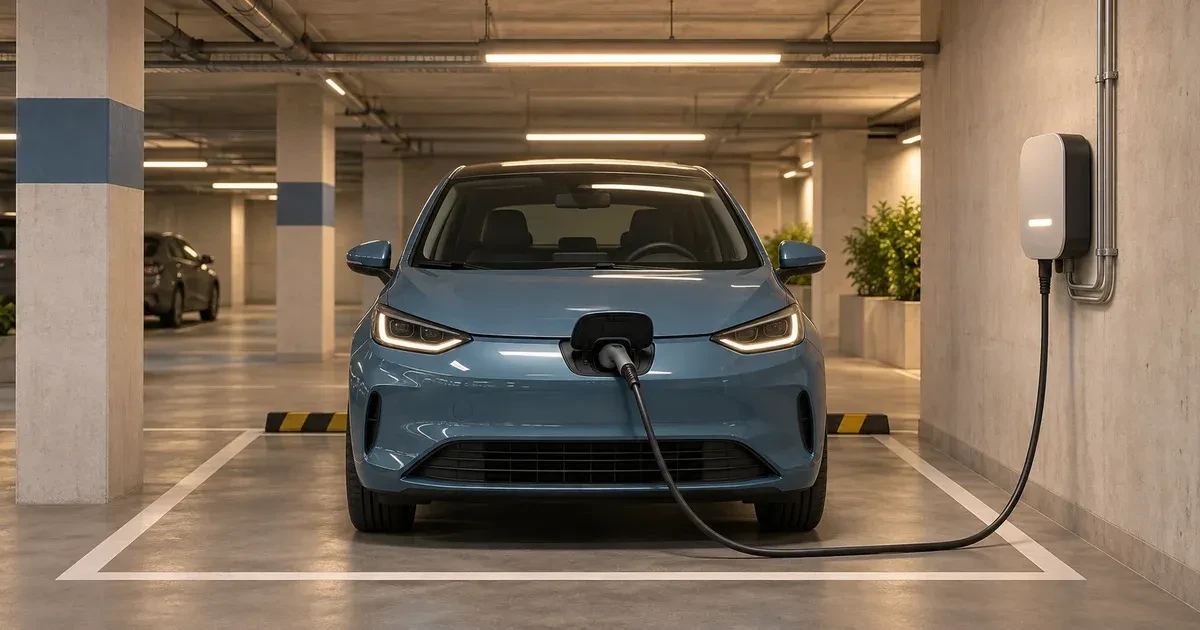
AI-generated illustration. Not a real development, map, client or transaction.
Owning a parking space does not, on its own, tell you whether you can charge an electric car there. Before buying, establish where the electricity would come from, what can be installed at the particular space, how consumption would be measured and who would arrange any necessary approvals. “You can add a charger” is not a substitute for a technical answer.
The best time to ask is while you are still choosing the apartment and parking space. You can then compare more than the price and room for manoeuvring. You can check whether the purchase suits the way you intend to use it. If home charging is essential, do not leave the discussion until after signing.
What does “prepared for a charger” actually include?
Ask the seller to explain this description for the specific parking space, not the building in general. A planned cable route, an installed cable and an operational charging point are different provisions. Compare them through the evidence you can request.
| What is being offered | What to request |
|---|---|
| A planned cable route | A plan showing its start and end, plus the work left for the buyer |
| A cable installed to the space | A technical description and confirmation of the remaining work before use |
| An installed charging point | Model details, installation and commissioning records, access and payment terms |
This is a way to ask precise questions, not a technical classification or a statement about equipment at Pirotska. Do not treat a socket on a nearby wall as confirmation that the installation is ready for your car.
Check the supply before choosing the equipment
ERM West distinguishes premises without a supply, which require a connection process, from already supplied premises. For the latter, the available capacity must cover the charger and other simultaneous consumption. If more is needed, an assessment for an increase is required. The operator recommends a qualified inspection and warns against extension-lead charging. ERM West’s official procedure.
For a buyer, the practical question is which supply would serve the proposed charging point. Would it come from the apartment, a separate supply point or a shared arrangement for the garage? Who can confirm the proposal, and on what documentation? Avoid making your own decision based solely on the power rating printed on a charger.
Before ordering equipment, discuss the vehicle, mounting position and parking arrangement with a qualified installer. The instructions for the chosen product matter too. For example, Tesla Wall Connector safety guidance calls for trained, qualified personnel. This illustrates a product-specific requirement; it is not a recommendation to choose that brand.
You own the space, but where would the cable run?
Treat the documents for the parking space and the proposed installation as separate questions. Ask what exactly you are acquiring and how use of the space is documented. Then establish whether the proposed route passes through common areas, someone else’s property or existing services.
Do not assume that ownership of the space permits any work you wish to carry out in the garage. Equally, do not assume that every charger requires the same procedure. Request a review of the actual documents and proposed work. For common areas, Bulgaria’s Condominium Ownership Management Act, published by the Ministry of Regional Development, is a starting point; the applicable decisions and approvals must be established for the individual case.
For a building under construction, raise these questions with the seller and design team before agreeing alterations. In an occupied building, involve the condominium management. In either case, establish who obtains the documents, commissions the work and accepts the completed installation.
How will you pay for electricity?
Ask for a proposal explaining how your consumption would be separated from everyone else’s. Is it individually measured? Who can see the readings, and who charges you? For a shared system, also ask about access, maintenance and any recurring fees. Do not assume that every arrangement involves a separate utility account or that a phone application settles the billing question.
To compare quotations, request separate descriptions of the equipment, design preparation, cable route, installation, necessary approvals and commissioning. Not every item will apply, but this makes exclusions visible. An inexpensive charger does not necessarily mean an inexpensive completed installation.
It is also worth asking what happens when you sell the apartment or change vehicles. Which records, access credentials and agreements would need to be handed over? These may feel like small details at a first viewing, but they matter to the long-term use of the space.
A question to send before reserving
You can ask for the following written clarification:
“I am interested in an apartment and a specific parking space where I could charge an electric car. Please explain what the design provides for that space, the proposed electricity supply, any outstanding work or approvals, and how consumption would be measured. Which elements are included in the offer?”
For Pirotska, start with the apartment and parking catalogue and identify the particular property in your enquiry. The presence of parking spaces in the catalogue does not itself confirm charging infrastructure. This article does not claim that any particular space in the development is equipped or suitable for installation without further checks.
The purpose is not to demand a finished electrical design during a first conversation. It is to distinguish what has been documented from what remains an assumption. If charging is a condition of your purchase, have the agreed provision described clearly in the transaction documents, with professional advice where needed.
Frequently asked questions
Does buying a parking space include the ability to charge an electric car?
Do not assume that it does. Check the description of the space, the electrical proposal and the equipment included in the agreement separately. Request confirmation for the actual parking space rather than a general statement about the building.
How is a cable route different from a ready-to-use charging point?
A route indicates the planned path of the installation. It does not by itself establish that a cable, charger and complete arrangements for use and measurement are in place. Clarify the outstanding work and who pays for it.
Will the charger need its own electricity account?
Ownership of a parking space does not determine that answer. Request a technical proposal for supply and measurement and, where necessary, the network operator’s assessment. Do not assume that every building uses the same arrangement.
Does Pirotska offer installed charging stations?
The public catalogue reviewed for this article does not confirm charging equipment for individual parking spaces. Ask the project team for current technical information about the space you are considering before making charging a condition of your purchase.
Sources checked on 5 November 2026. This is a practical buying guide, not an electrical design or individual legal opinion. Linked Bulgarian sources concern the local procedure.